How to Fold an Origami Lucky Star
An origami lucky star is a tiny, puffy five-pointed star made by knotting a long paper strip into a pentagon and wrapping it. It is easy and takes about three minutes, though the final puffing step needs a light touch.
- Difficulty
- Easy
- Time
- About 3 min
- Steps
- 6
- Paper
- A narrow strip about 30 cm long and 1.5 cm wide (12 × 1/2 in); cut one from the long side of A4 or Letter paper
Near one end of the strip, curl it into a loop and thread the short end through, the way you would start a loose overhand knot.
Tip: swipe the diagram, or use ← → on your keyboard. Space plays and pauses.
All steps
Advertisement
Step-by-step instructions
The same 6 steps as the animation above, written out so you can fold away from the screen.
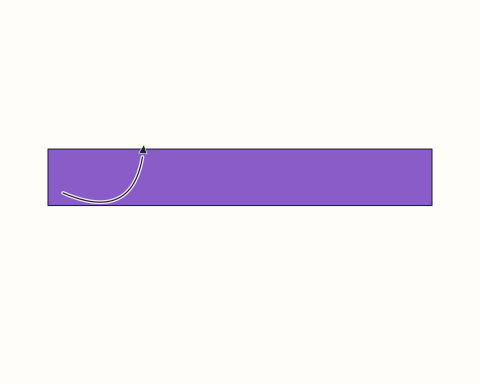
Step 1
Near one end of the strip, curl it into a loop and thread the short end through, the way you would start a loose overhand knot.
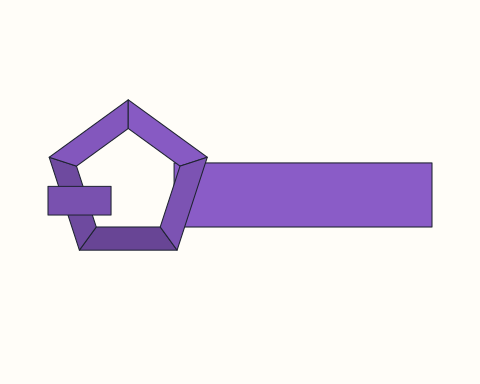
Step 2
Ease both ends until the knot draws tight, then flatten it carefully into an even pentagon and sharpen each of its edges.
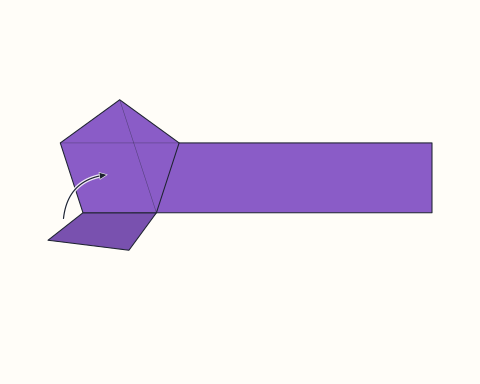
Step 3
Bring the short tail across the pentagon and slip it inside, or simply snip it off.
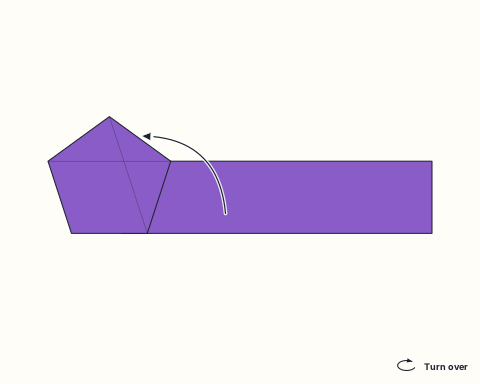
Step 4
Wind the long tail around the knot: fold it across wherever it reaches an edge, flip the pentagon, and fold once more. By tracking the edges every time, you keep five equal sides while the layers build up.
Advertisement
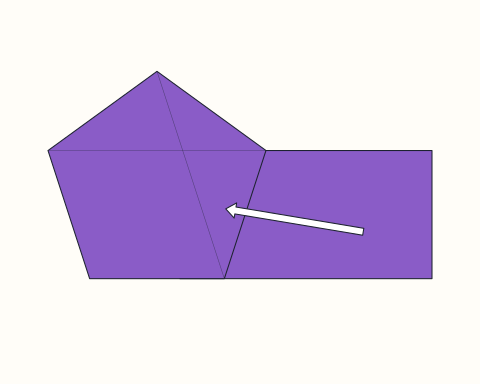
Step 5
Continue wrapping until only a short end remains, then tuck it beneath the previous layer.
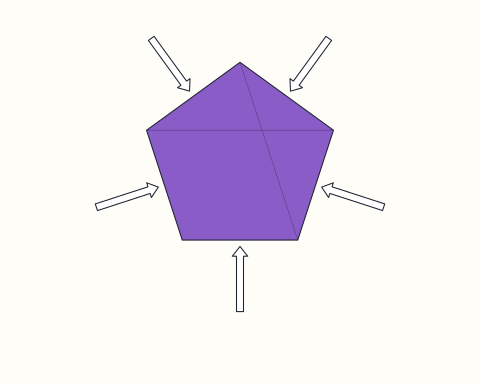
Step 6
Hold the pentagon gently and press a fingernail into the midpoint of each side, working around one side at a time. As each side caves in, the star swells into shape.
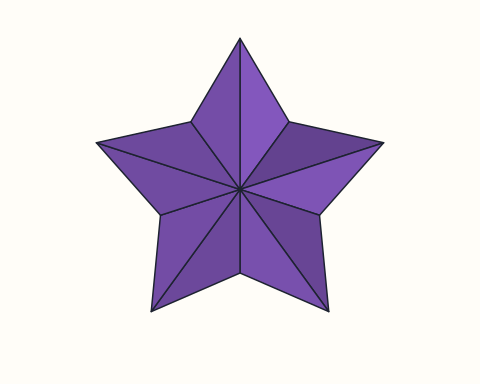
Finished
The lucky star is complete. Many people fill a jar with them in assorted colors; 365 stars for a year of wishes is a popular custom, and a thousand makes a generous gift.
About the origami lucky star
Lucky stars, sometimes called wishing stars, are small puffy stars folded from a narrow strip of paper rather than a square. They became a popular craft across East Asia and are now folded around the world, often by the hundred. Their appeal lies in the collection: a glass jar filled with colorful stars makes a thoughtful handmade gift that shows the time invested in it. Each star is only a couple of centimeters across, so they are easy to carry, scatter on a table as confetti, or string on thread as a delicate garland.
Unlike most origami, this model is built by tying and wrapping instead of folding a flat sheet. You tie a flat knot that naturally forms a pentagon, then wind the rest of the strip around it, always folding along an edge. The last step, pressing each side inward, turns the flat pentagon into a three-dimensional star. Along the way it teaches patience, consistent tension and precise edge alignment. Because the motion is repetitive and soothing, many people fold stars while chatting, listening to music or watching something, and soon produce a full jar.
The strip leaves plenty of room for variation. Wider strips make chunkier stars, gift wrap and magazine pages give unusual patterns, and a message written on the strip before folding stays hidden until someone unrolls it. Once you are quick at stars, pair them with other symbolic gifts such as the Heart or a Paper Crane. A Masu Box folded from decorative paper makes a charming container for a handful of stars, and a set of Tulips can round out a paper bouquet for a birthday or anniversary.
Origami lucky star: questions
How long should the paper strip be for a lucky star?+
A good ratio is about 20 times longer than it is wide, such as 1.5 × 30 cm. Wider strips make bigger stars, and a longer strip gives more wraps and a plumper star. A strip cut along the long side of A4 or Letter paper is a convenient size.
Why won’t my star puff up?+
Usually the wraps are too tight or the edges were not pressed sharply. Wrap snugly but not hard, and make sure there is a slight gap inside. Then push the middle of each edge firmly with a fingernail rather than a fingertip.
What are lucky stars used for?+
They are popular across East Asia as small keepsakes and are often collected in glass jars. People fold them as gifts, as a wish for each day, or as decorations. Some write a short message on the strip before folding so it is hidden inside.
Can I write a message inside a lucky star?+
Yes. Write along the inside of the strip before you tie the knot. Once wrapped, the words are hidden, and the recipient can unroll the star to read them.
Fold this next
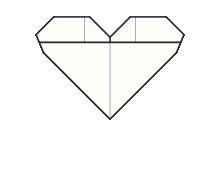
Origami Heart
The origami heart is a flat, symmetrical heart shape folded from one square, ideal for slipping into a card or envelope. It is an easy model that takes around five minutes and uses only simple valley and mountain folds.
Masu Box
The masu box is a traditional Japanese square box folded from a single sheet that locks together without glue. It is an intermediate model that takes about eight minutes, with one three-dimensional step where the walls are raised.
Paper Crane
The origami crane is the traditional Japanese orizuru, a bird with spread wings folded from a single square without cuts or glue. It is an advanced model: expect about 15 minutes for your first one, mostly spent learning the petal fold and inside reverse fold.
Tulip
The origami tulip is a flat flower head made from a single square in three folds, designed to be joined to a separate folded stem. It is one of the easiest models on the site and takes about three minutes.