How to Fold an Origami House
The origami house is a classic flat model of a house with a sloping colored roof above white walls, folded from one square. It is easy, takes about three minutes, and is one of the best models for learning the squash fold.
Quick answerThe origami house is an easy model folded in 5 steps and about 3 minutes, using the crease and squash fold. You need a 15 cm (6 in) square; the colored side becomes the roof and the white side the walls.
- Difficulty
- Easy
- Time
- About 3 min
- Steps
- 5
- Paper
- A 15 cm (6 in) square; the colored side becomes the roof and the white side the walls
Place the square with the white side facing you. Bring the top edge down to the bottom edge and crease, so you have a wide rectangle with the fold at the top.
Tip: swipe the diagram, or use ← → on your keyboard. Space plays and pauses.
All steps
Advertisement
Step-by-step instructions
The same 5 steps as the animation above, written out so you can fold away from the screen.
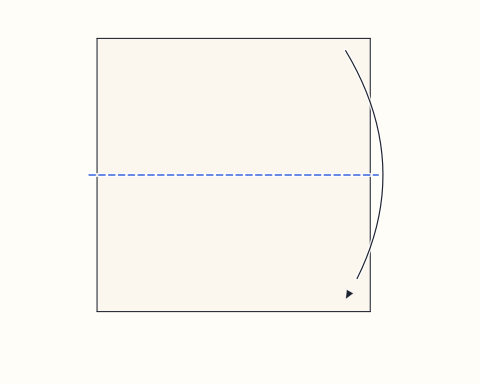
Step 1
Place the square with the white side facing you. Bring the top edge down to the bottom edge and crease, so you have a wide rectangle with the fold at the top.
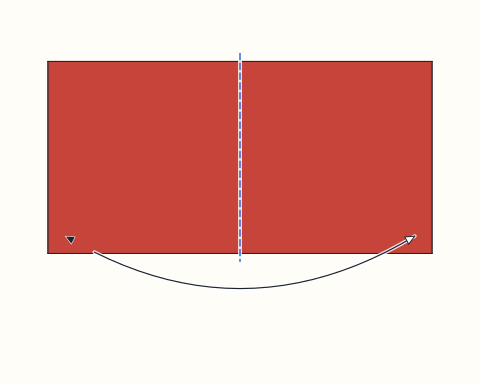
Step 2
Fold the rectangle in half from left to right, press a crease, and open it again to mark the vertical center line.
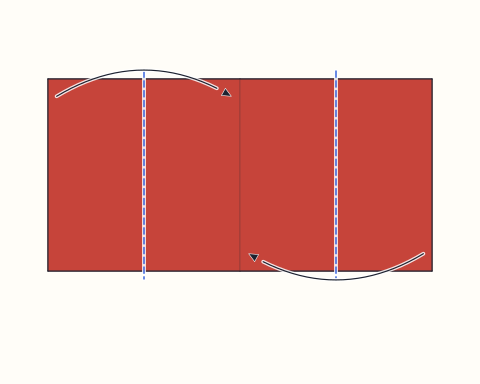
Step 3
Fold the left edge and the right edge in so they meet on the center crease. You now have a square with two flaps in front.
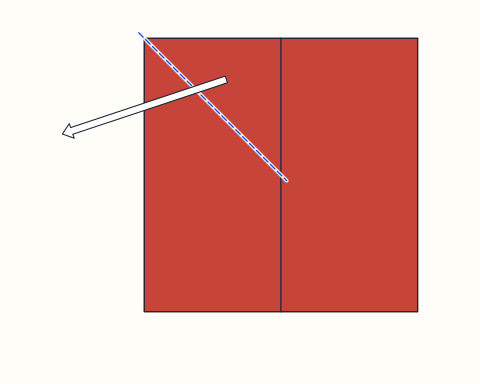
Step 4
Lift the left flap so it stands up, open it from underneath, and press its top corner down so the flap squashes flat into a triangle. The triangle forms one half of the roof, and the white wall appears below it.
Advertisement
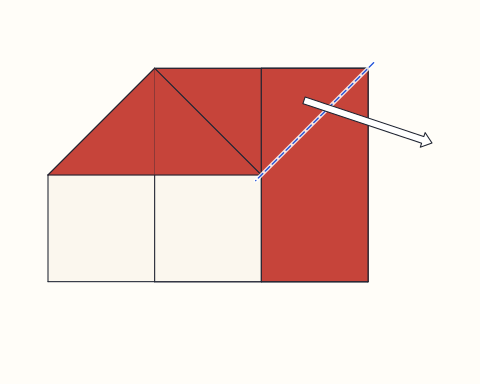
Step 5
Squash the right flap in exactly the same way. The two triangles and the colored strip between them make one continuous roof.
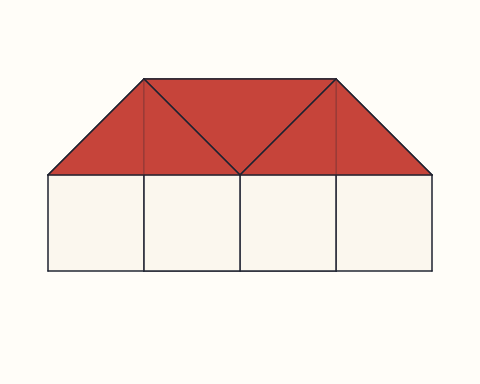
Finished
The house is finished: a colored roof sits on top of white walls. Draw a door, windows and a chimney, or fold several houses in different colors and line them up as a street.
About the origami house
The flat house is a traditional model that has been taught to children for generations, and it is often one of the first designs in beginner origami books. From a single square it produces a recognizable home with a sloping roof, a straight ridge and two walls, and it leaves plenty of white space for drawing a door and windows. Because it is so quick, it is popular for greeting cards, housewarming notes and classroom projects in which every child folds a house and the class builds a paper village together.
Beyond being charming, the house is an ideal introduction to the squash fold. The two flaps you create in step 3 are wide and sit on top of a flat base, so there is room to open them and watch how the layers spread into a triangle. The same move later helps you make the preliminary base and the petal folds of the Paper Crane, where it is smaller and less forgiving. Learning it here, with large paper and only a few layers, builds confidence and a feel for how paper redistributes itself when a flap is opened and flattened.
Try folding houses in several colors and drawing different doors, curtains and chimneys on each one. A row of houses with a Christmas Tree beside it makes a lovely winter card, and the Sailboat pairs well with a house for a seaside picture. If you enjoyed the squash fold, the Pinwheel and the Paper Boat use closely related moves, and the Masu Box is a good next step when you want a practical model with more precise folding.
Origami house: questions
What is a squash fold?+
A squash fold opens a flap that has two layers and presses it flat into a new shape, usually a triangle or a diamond. In the house, each side flap is squashed into a triangular half of the roof. It is a basic origami technique that appears in many bases and models.
Is the origami house easy enough for kids?+
Yes. The first three folds are simple edge-to-edge folds, and the squash fold is gentle because the flaps are large. Children around six and up can usually do it after watching the animation once.
How can I make my origami house stand up?+
This version is flat. You can fold a strip of card behind it as a stand, or glue it to a folded greeting card so it stands when the card is opened.
What can I do with an origami house?+
Houses make good greeting cards, gift tags and name cards, and a row of them makes a street scene on a classroom wall. Some people write an address or a moving-day message on the white walls.
Fold this next
Christmas Tree
The origami Christmas tree is a flat fir tree with three stepped tiers and a small trunk, folded from one square without cutting. It is an easy model that takes about five minutes; the only new idea is a simple pleat that creates each tier.
Sailboat
The origami sailboat is a flat picture of a boat, with a colored triangular sail standing on a white hull, folded from one square without cuts. It is very easy: five simple folds and about three minutes, which makes it a good first model for children.
Pinwheel
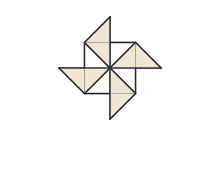
The origami pinwheel is a flat four-bladed model folded from the traditional windmill base that can be pinned to a stick so it spins in the wind. It is an intermediate model taking about six minutes, with one careful step where hidden corners are pulled out.
Masu Box
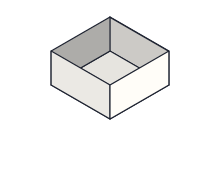
The masu box is a traditional Japanese square box folded from a single sheet that locks together without glue. It is an intermediate model that takes about eight minutes, with one three-dimensional step where the walls are raised.