How to Fold an Origami Christmas Tree
The origami Christmas tree is a flat fir tree with three stepped tiers and a small trunk, folded from one square without cutting. It is an easy model that takes about five minutes; the only new idea is a simple pleat that creates each tier.
Quick answerThe origami christmas tree is an easy model folded in 7 steps and about 5 minutes, using the crease and pleat. You need a 15 cm (6 in) square, green on one side and white on the other.
- Difficulty
- Easy
- Time
- About 5 min
- Steps
- 7
- Paper
- A 15 cm (6 in) square, green on one side and white on the other
Turn the square so it sits like a diamond with the white side facing you. Fold it in half from the left corner to the right corner, then open it to leave a vertical crease.
Tip: swipe the diagram, or use ← → on your keyboard. Space plays and pauses.
All steps
Advertisement
Step-by-step instructions
The same 7 steps as the animation above, written out so you can fold away from the screen.
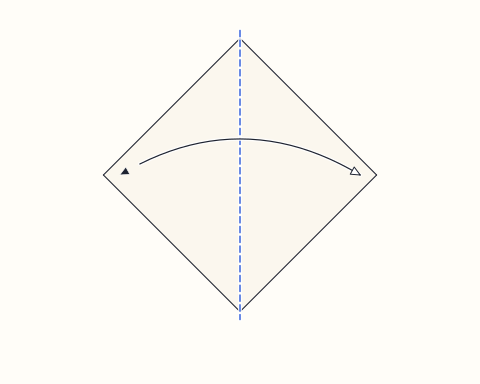
Step 1
Turn the square so it sits like a diamond with the white side facing you. Fold it in half from the left corner to the right corner, then open it to leave a vertical crease.
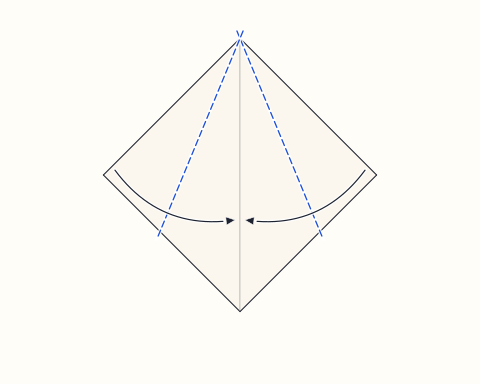
Step 2
Fold the two upper edges in so they lie along the center crease. The green flaps meet in the middle and form a tall kite with its point at the top.
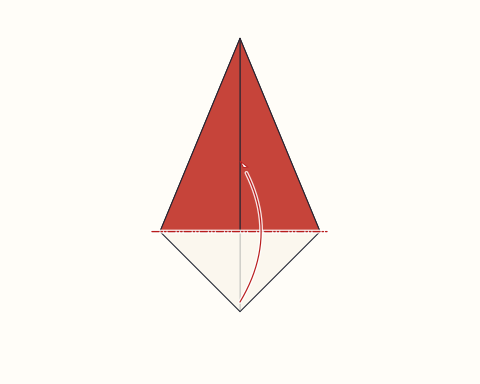
Step 3
Fold the white triangle at the bottom up behind the model, folding along the line that joins the kite's two side corners. The front is now a green triangle.
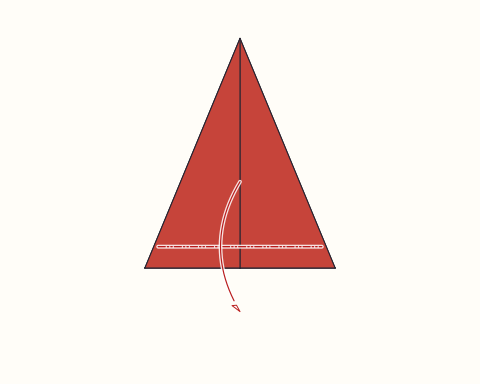
Step 4
Reach behind and fold the point of that hidden triangle back down, so a white point sticks out below the bottom edge of the tree. This is the trunk.
Advertisement
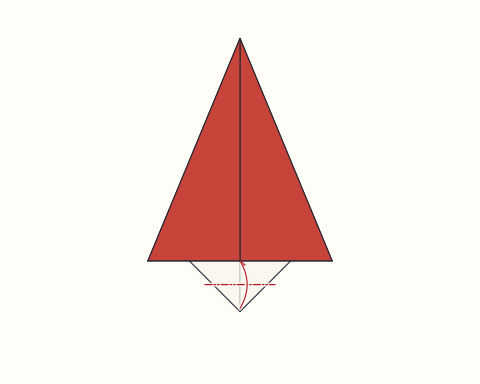
Step 5
Fold the very tip of the trunk up behind the model, so the trunk has a flat bottom.
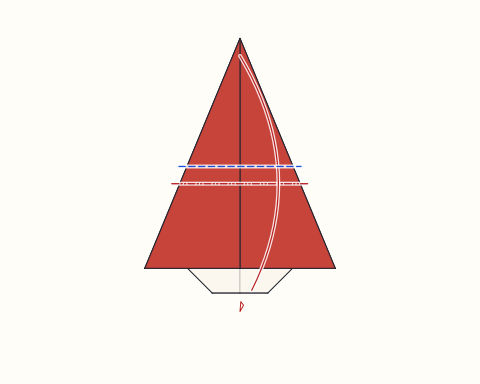
Step 6
Make the first tier with a pleat: mountain fold the upper part of the tree behind along a horizontal line, then valley fold it back up along a line slightly higher. The top of the tree slides down and a small step appears on each side.
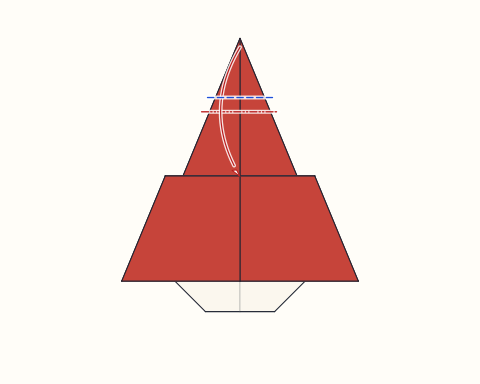
Step 7
Make a second, smaller pleat nearer the top in the same way. You now have three tiers stacked above the trunk.
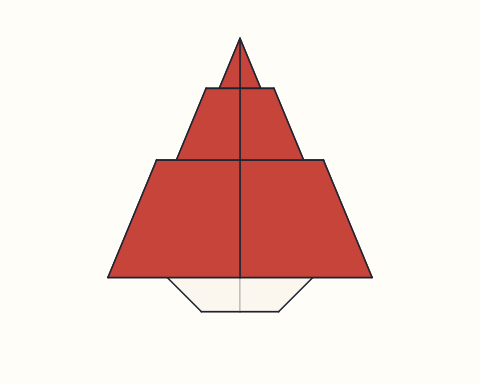
Finished
Your Christmas tree is finished. Glue a small star on the top, dot on baubles with a gold or silver pen, and use it on a card, a gift tag or a garland.
About the origami christmas tree
Paper trees are a long-standing favorite for handmade holiday decorations, and simple flat versions like this one are easy to fold in quantity for cards, table settings and window displays. This tree begins with the kite, one of the most common starting shapes in origami, and then uses folds behind the model to shape a trunk and pleats to form tiers. The result reads immediately as a fir tree, even at small sizes, and its flat back makes it easy to glue onto paper or card.
The model is a gentle introduction to the pleat, a fundamental technique made from a mountain fold and a valley fold side by side. Pleats appear throughout origami, from the spring of the Jumping Frog to fans, tails and many animal ears. Here the effect of each pleat is easy to see: the upper part of the tree slides down and the sides step inward, just like the branches of a real fir. The trunk steps also show how a hidden layer can be folded back out to create a new feature in a different color.
For a festive set, fold trees in several shades of green and group them on a card as a small forest, with a Lucky Star above for the top. The House pairs beautifully with a tree for a snowy village scene, and a string of Hearts or Lucky Stars makes a companion garland. If you want a gift box to go under your paper tree, the Masu Box is the traditional choice and holds small presents or sweets.
Origami christmas tree: questions
What is a pleat in origami?+
A pleat is a pair of parallel folds, one mountain and one valley, that makes a zigzag in the paper. In this tree each pleat shortens the upper part so it steps in, which creates the layered outline of a fir tree.
How do I make a 3D origami Christmas tree?+
This diagram shows a flat tree for cards and decorations. Three-dimensional trees are usually built from several stacked units or from a preliminary base with many reverse folds, and they need more steps and more precise folding.
What size paper is best for an origami Christmas tree?+
A 15 cm square gives a tree about 10 cm tall, a good size for a greeting card. Smaller 7.5 cm squares make tiny trees for gift tags, and larger squares suit wall decorations.
Can kids fold this Christmas tree?+
Yes. Most steps are straight folds with clear landmarks, and the pleats are simple once shown. Children around six or seven can usually fold it with a little help on the first pleat.
How can I decorate origami Christmas trees?+
Draw ornaments with metallic pens, glue on sequins or tiny paper stars, or punch small holes and thread them onto string as a garland. Patterned paper also gives an instant decorated look.
Fold this next
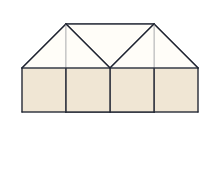
House
The origami house is a classic flat model of a house with a sloping colored roof above white walls, folded from one square. It is easy, takes about three minutes, and is one of the best models for learning the squash fold.

Lucky Star
An origami lucky star is a tiny, puffy five-pointed star made by knotting a long paper strip into a pentagon and wrapping it. It is easy and takes about three minutes, though the final puffing step needs a light touch.
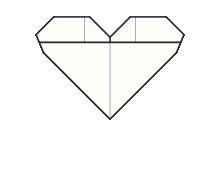
Origami Heart
The origami heart is a flat, symmetrical heart shape folded from one square, ideal for slipping into a card or envelope. It is an easy model that takes around five minutes and uses only simple valley and mountain folds.
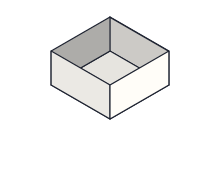
Masu Box
The masu box is a traditional Japanese square box folded from a single sheet that locks together without glue. It is an intermediate model that takes about eight minutes, with one three-dimensional step where the walls are raised.