Skip to content
origamidiagrams

Kite base

The kite base is the simplest traditional starting shape: a square with two neighboring edges folded to a diagonal crease, so it looks like a kite.

Turn the square so it sits as a diamond, fold it in half along one diagonal and open it again. Then fold two edges that share a corner inward so they lie exactly along that crease. The result is a long, symmetrical kite with a broad end and a sharp point. Many simple animals, fish and flower stems begin this way.

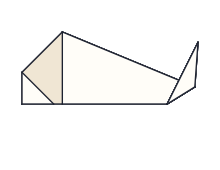
The usual mistake is letting the folded edges overlap or leave a gap along the center crease, which makes the kite lopsided. Hold each edge on the crease along its whole length before pressing, starting at the sharp point. On this site the Fish and the Tulip Stem both open with a kite base.

How to fold a kite base, step by step

  1. 1

    Place the square as a diamond, with a corner pointing toward you.

  2. 2

    Fold it in half from the left corner to the right corner and unfold, leaving a vertical crease.

  3. 3

    Fold one lower edge in so it lies exactly along the crease.

  4. 4

    Fold the other lower edge in the same way, so the two edges meet on the crease.

  5. 5

    Press flat: you have a kite with a sharp point at one end and a broad end at the other.
Advertisement

Common mistakes and how to fix them

  • The kite is lopsided

    One edge overlaps the crease or leaves a gap. Start aligning at the sharp point and hold the edge on the crease along its whole length.

  • The point is blunt or uneven

    The vertical crease missed the corners. Refold it exactly corner to corner.

  • The flaps spring open

    Crease firmly from the sharp point outward and the flaps will stay in place.

When you’ll use it

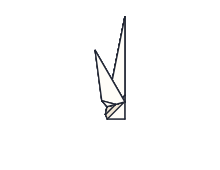
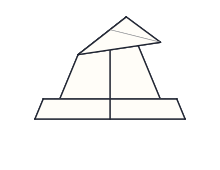
The kite base is the friendliest base in origami because every fold lines up with something you can see: an edge, a corner or the center crease. That makes it ideal for children and first-time folders. It also teaches the idea behind every base: a shape with a long point and a broad end that can each become something. The long point becomes a tail, a stem or the tip of a hat; the broad end becomes a body, a head or a brim. The Swan narrows its kite a second time to make a long neck. When you are ready for more, the fish base builds directly on it.

Practice it on these models

Kite base: questions

Which models start from a kite base?+

On this site the Fish, the Tulip Stem and the Witch Hat open with a kite base, and the Swan and the Christmas Tree begin with the same kite shape.

Is the kite base the same as the fish base?+

No. The fish base makes kite creases at both ends of the diagonal and then collapses each end as a rabbit ear, so it has two extra small flaps.

Is the kite base good for children?+

Yes. Every fold lines up with an edge or the center crease, so young children can fold it with little help. Use a large square, about 20 cm, and let them press each fold flat before moving on.