How to Fold an Origami Fortune Teller
The origami fortune teller is a four-pointed paper game, also known as a cootie catcher or chatterbox, that opens and closes on your fingers to reveal hidden messages. It is an easy model folded from one square with only corner-to-centre folds and takes about five minutes, plus a few more to write the fortunes.
Quick answerThe origami fortune teller is an easy model folded in 6 steps and about 5 minutes, using the crease and blintz fold. You need one square of thin paper, 15–20 cm (6–8 in); printer paper cut square is ideal because it takes pen well.
- Difficulty
- Easy
- Time
- About 5 min
- Steps
- 6
- Paper
- One square of thin paper, 15–20 cm (6–8 in); printer paper cut square is ideal because it takes pen well
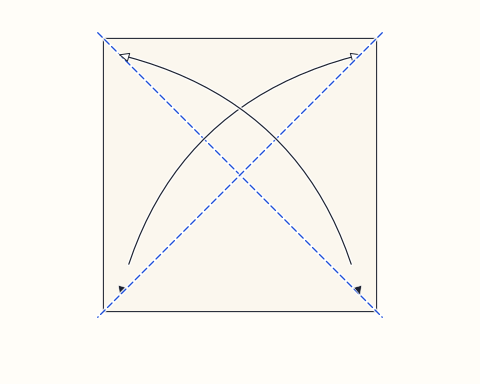
Lay the square white side up. Fold it corner to corner along one diagonal and open it, then do the same along the other diagonal, so two creases cross in the middle.
Tip: swipe the diagram, or use ← → on your keyboard. Space plays and pauses.
All steps
Advertisement
Step-by-step instructions
The same 6 steps as the animation above, written out so you can fold away from the screen.
Step 1
Lay the square white side up. Fold it corner to corner along one diagonal and open it, then do the same along the other diagonal, so two creases cross in the middle.
Step 2
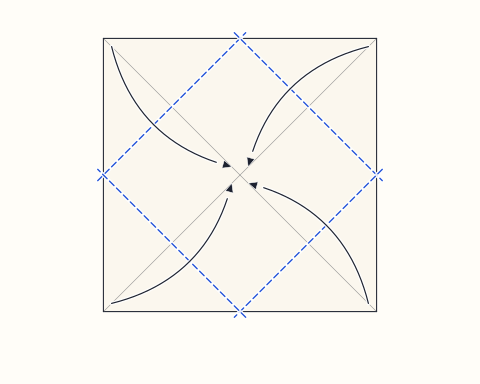
Bring each of the four corners in to the point where the creases cross and flatten them. The paper is now a smaller square turned like a diamond.
Step 3
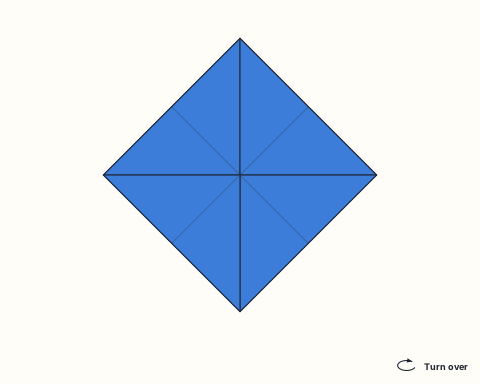
Flip the paper over so the smooth side faces you.
Step 4
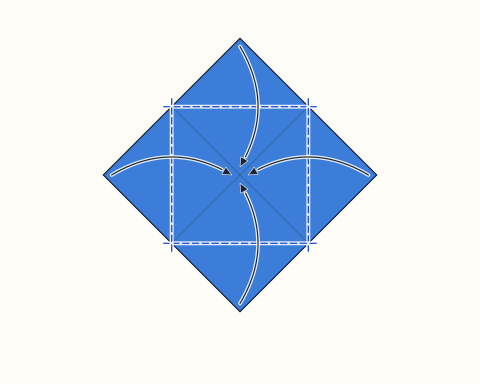
Once more, fold every corner in to the centre, pressing firmly because you are now folding through several layers. You end with a small square covered by four triangles.
Advertisement
Step 5
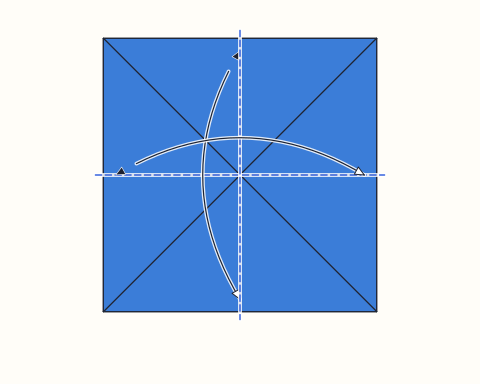
Fold the square in half from edge to edge and open it, then fold it in half the other way and open it. Keep the triangles on the inside of each fold so the creases bend the right way later.
Step 6
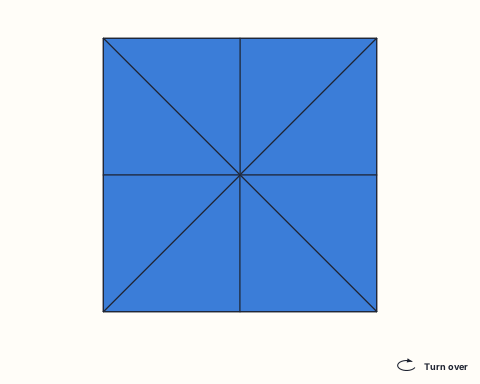
Flip the paper over again. The side now facing you has four small square flaps, and these are the pockets your fingers will go into.
Finished
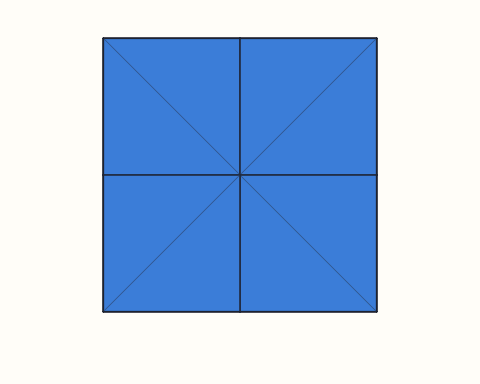
Push a thumb and forefinger under each pair of square flaps, press the four corners up and together until they meet in a point, and the fortune teller springs into shape. Spread your fingers apart and together to open it one way, then pinch the other way to open it across.
About the origami fortune teller
The fortune teller is a traditional model with no known inventor, folded by children in many countries and known by many names: cootie catcher, chatterbox, salt cellar, whirlybird and more, depending on where you grew up. It is built from a square that is blintzed twice, meaning the corners are folded to the centre two times, and then creased in half both ways so it can flex. The finished form has four hollow points on the outside and eight triangular faces on the inside, which is exactly what makes it such a good carrier for a guessing game.
The game is simple and endlessly adaptable, which is why the fortune teller turns up in playgrounds, classrooms and party bags. Teachers use it for spelling practice, maths facts and conversation prompts, while at home it becomes a joke machine or a way to choose who washes up. Because every choice is made by counting moves, it also quietly practises counting and taking turns for younger children. The folding itself is a gentle introduction to the blintz fold, a technique that appears in many other traditional models such as the Masu Box.
Once you know the base, it is easy to vary. Folding from larger paper makes a puppet-sized fortune teller, and drawing eyes around one point turns it into a talking bird or monster mouth. For more paper toys, try the Jumping Frog or the Pinwheel, and for another quick project that doubles as a gift, fold a Corner Bookmark or an Origami Envelope to carry a handwritten note.
Origami fortune teller: questions
How do you play with a paper fortune teller?+
Write a colour on each of the four outer squares, a number on each of the eight inner triangles, and a short message under each triangle. A friend picks a colour and you open and close the fortune teller once per letter as you spell it. They then pick a visible number and you count that many moves, and finally they choose a number and you lift that flap to read the message.
Why is it called a cootie catcher?+
In North America children sometimes play at catching imaginary cooties, a slang word for lice or germs, by snapping the points of the fortune teller like a beak. The same model is called a chatterbox in Britain and a salt cellar in some places, because the four pockets can stand upright and hold small things.
What should I write inside a fortune teller?+
Anything short enough to fit under a triangle works: silly fortunes, jokes, dares, compliments, or classroom uses such as vocabulary questions and times-table facts. Keep each message to a few words and write lightly in pencil first if you want to change them later.
What paper is best for a fortune teller?+
Ordinary printer paper cut to a square is the best choice for most people. It is stiff enough to hold its shape through lots of opening and closing, and pens and markers do not bleed through it. Very thin origami paper tears at the pockets more quickly.
Why won't my fortune teller open both ways?+
Usually one of the halving creases from step 5 is weak or was folded the wrong way. Flatten the model, refold both halves firmly with the triangles inside, and ease it open slowly the first time so the creases settle.
Fold this next
Jumping Frog
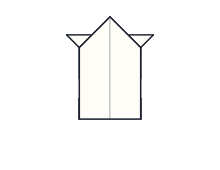
The origami jumping frog is a traditional action model folded from a stiff rectangle that springs forward when you press and release its back. It is an intermediate model that takes about six minutes, mostly for the collapse and the zigzag spring.

Pinwheel
The origami pinwheel is a flat four-bladed model folded from the traditional windmill base that can be pinned to a stick so it spins in the wind. It is an intermediate model taking about six minutes, with one careful step where hidden corners are pulled out.
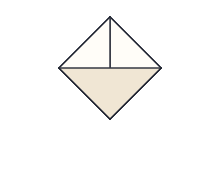
Corner Bookmark
The origami corner bookmark is a small square with a triangular pocket that slides over the corner of a page to mark your place. It is an easy model folded from one square in four steps and takes about three minutes, which makes it a favourite classroom craft.
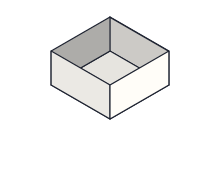
Masu Box
The masu box is a traditional Japanese square box folded from a single sheet that locks together without glue. It is an intermediate model that takes about eight minutes, with one three-dimensional step where the walls are raised.