Quick answer
Origami developed its richest tradition in Japan, where paper folding was used for ceremonial wrapping and, by the Edo period, for recreation; the earliest known book of recreational origami, Hiden Senbazuru Orikata, was published in 1797. Europe had its own folding traditions, and in the twentieth century Akira Yoshizawa’s creative models and diagram notation, standardized as the Yoshizawa–Randlett system, turned origami into a global art.
First, there had to be paper
Paper folding needs paper, and papermaking was developed in China. The technique spread gradually across Asia and reached Japan by around the seventh century. How and when people first began folding paper for its own sake is not recorded, and claims of an exact origin date should be treated with caution. Paper was valuable for a long time, which helps explain why early folding in Japan was associated with ceremony rather than play.
Ceremonial folding in Japan
In Japan, folded paper became part of ritual and etiquette. Paper was folded into zigzag streamers used at Shinto shrines, and formal gift wrapping, known as origata, developed into a refined set of conventions. A well-known example is noshi, a folded paper ornament traditionally attached to gifts as a token of good wishes. These ceremonial folds were about correct form and meaning rather than making figures of animals or objects.
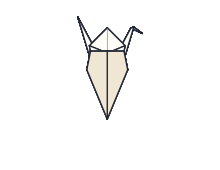
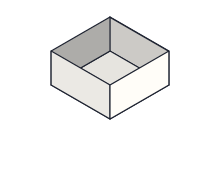
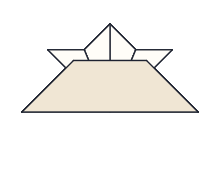
Recreational folding, making cranes, boxes and other figures for pleasure, is well documented by the Edo period (1603–1868). Traditional models that are still folded today, including the crane, the Masu Box and the Samurai Helmet (kabuto), come from this Japanese tradition. Like most traditional models, they have no known individual inventor.
Advertisement
Senbazuru and the earliest origami book
The earliest known book devoted to recreational paper folding is Hiden Senbazuru Orikata, published in Kyoto in 1797. Its title is usually translated as “The Secret of One Thousand Cranes Folding”, and it shows how to fold groups of cranes that remain joined together, cut and folded from a single sheet. It is often cited as a landmark in origami history.
Senbazuru today usually means something different: a string of one thousand folded cranes. The crane is associated in Japan with long life and good fortune, and a senbazuru is traditionally linked to a wish being granted. Strings of cranes are given at weddings, for recovery from illness and as prayers for peace.
That last association grew from the story of Sadako Sasaki, a girl from Hiroshima who developed leukemia after the 1945 atomic bombing and folded paper cranes while in hospital. She died in 1955. The Children’s Peace Monument in Hiroshima Peace Memorial Park honors her, and visitors still leave strings of cranes there. You can fold your own with our Paper Crane diagram.
The word origami combines the Japanese oru (to fold) and kami (paper). Older Japanese terms such as orikata were used before origami became the standard word, and the Japanese term was adopted into English and many other languages during the twentieth century.
Paper folding in Europe
Europe developed folding traditions of its own. Elaborate napkin folding was a feature of grand dining in the seventeenth century, with cloth folded into animals and other shapes for banquet tables. In Spain, paper folding has a long popular tradition, symbolized by the pajarita, a small folded bird; the Spanish word papiroflexia is still used for origami.
In the nineteenth century, Friedrich Fröbel, the German educator who founded the kindergarten movement, included paper folding among his teaching activities as a way to explore shape, symmetry and geometry. Through kindergartens, folding exercises spread widely in Europe and beyond, and some models familiar to children today, such as simple boats and hats, were already common in this period. Some scholars also point to exchanges between Japanese and European folding after Japan opened to the West in the second half of the nineteenth century, when kindergarten education was introduced in Japan.
Akira Yoshizawa and the modern art
The person most responsible for origami as a creative art is Akira Yoshizawa (1911–2005). Rather than repeating traditional models, Yoshizawa created an enormous number of original designs, many of them lifelike animals with a sense of character and movement. He is also credited with developing wet-folding, in which slightly dampened paper is shaped into soft, rounded forms. His work was published and exhibited from the 1950s onward and became known outside Japan, inspiring folders around the world.
The Yoshizawa–Randlett system
Yoshizawa’s other lasting contribution was a clear, consistent way of drawing folding instructions. He used distinct line styles for folds that go toward or away from the viewer, and arrows to show movement. In the 1960s, the American writer Samuel Randlett and the British magician and author Robert Harbin adopted and extended this notation in their books. The result, known as the Yoshizawa–Randlett system, is the international standard for origami diagrams today: a dashed line for a valley fold, a dash-dot line for a mountain fold, and a shared set of arrows and symbols. Because the language is visual, a diagram drawn in Tokyo can be followed in Buenos Aires. Our origami symbols guide explains the marks.
Advertisement
Origami becomes worldwide
From the mid-twentieth century, origami spread through books, magazines and clubs. In the United States, Lillian Oppenheimer helped bring folders together in New York, work that led to the organization now called OrigamiUSA. The British Origami Society was founded in the 1960s, and national societies followed in many countries. Conventions allowed folders to share new designs, and a culture grew up of crediting creators for original models while treating traditional ones as shared heritage.
Mathematics, computers and new directions
Since the late twentieth century, origami has been transformed by mathematics. Folders and mathematicians began studying which shapes can be folded and how to plan the crease pattern for a desired structure. Designers such as Robert J. Lang developed methods, and computer programs, for designing models with a specific number and arrangement of points, which made extraordinarily complex insects and animals possible from a single uncut square.
Several new styles have grown alongside traditional folding:
- [Modular origami](/learn/modular-origami/), where many identical units are folded and slotted together into geometric forms. The Japanese artist Tomoko Fuse is especially well known for modular designs.
- [Tessellations](/learn/tessellation/), repeating patterns of folded tiles across a whole sheet, often studied for their mathematical structure.
- Engineering applications, where folding principles help pack large structures into small spaces. The Miura fold, devised by the Japanese astrophysicist Koryo Miura, is a well-known example studied for deployable structures such as solar panels.
Origami today
Today origami spans everything from a child’s first paper cup to gallery sculpture and research papers. Traditional models remain the common ground: almost every folder learns the crane, the boat and the Jumping Frog. Animated diagrams, like the ones on this site, are the newest chapter in a long history of finding clearer ways to show how a flat sheet becomes a form. If you are ready to add your own chapter, start with origami for beginners.