Quick answer
Standard origami paper, called kami, is thin, crisp and usually colored on one side; a 15 cm (6 in) square suits most models. Use larger 20–25 cm squares for beginners and children, small 7.5 cm squares for models you know well, thicker paper like tant for boxes, and foil or washi for special pieces.
What makes paper good for origami
Four properties decide how paper behaves when you fold it:
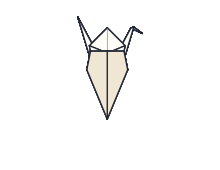
- Thickness. Thin paper keeps many layers flat, which matters for models like the Paper Crane where points are folded several layers deep. Thick paper gives stiff, sturdy results but becomes bulky quickly.
- Crease memory. Good origami paper holds a crease sharply and stays where you put it. Soft paper, such as tissue or many napkins, springs back and blurs lines.
- Strength. Paper with long fibers resists tearing at points where many folds meet. Cheap paper can split during a squash or reverse fold.
- Color on each side. Many models are designed to show one color outside and white inside. Paper colored on one side also makes diagrams easier to follow, because you can see at a glance which side is facing up.
Paper weight is often given in grams per square meter (gsm). As a rough guide, standard origami paper is lighter than everyday printer paper, which is commonly around 75–80 gsm, and card stock is much heavier still.
The main types of origami paper
Kami (standard origami paper)
Kami, from the Japanese word for paper, is the thin, inexpensive paper sold in packs of bright squares. It is usually colored on one side and white on the other, creases crisply and is forgiving enough for learning. If you buy only one kind of paper, buy a pack of 15 cm kami. It suits almost every model on this site.
Washi
Washi is traditional Japanese paper made from long plant fibers, often from the kozo (mulberry) plant. It is soft to the touch yet strong, with a slightly textured surface. Printed washi with small repeating patterns is often called chiyogami or yuzen. Washi is lovely for gifts and display pieces such as a Masu Box or Heart, though its softness means creases are a little less sharp than kami.
Foil paper
Foil paper has a thin metallic layer bonded to paper. It holds a shape extremely well, so you can bend and sculpt points, and it looks festive. The downside is that every mistaken crease stays visible, and thick foil tears at sharp points. Save it for models you already know, such as stars and cranes for decorations.
Tant
Tant is a Japanese paper that is heavier than kami, with a slightly textured surface and the same color on both sides. It holds a crisp crease and gives firm walls, which makes it a favorite for boxes and geometric models. It is too thick for small, many-layered models.
Duo paper
Duo paper has a different color on each side. It shows off models where both sides are visible, like the Pinwheel, whose blades alternate colors.
Printer and copy paper
Ordinary printer paper is free, easy to find and fine for simple models with few layers. Cut A4 or Letter into a square using our guide to making square paper, or print colored squares at exact sizes with the printable origami paper tool. Newspaper is great for large, wearable models like the Samurai Helmet.
Specialty papers
Experienced folders also use thicker papers designed for wet-folding, where the paper is slightly dampened so it can be sculpted into rounded forms, and very thin laminated papers for complex models with many points. You do not need any of these to start.
Advertisement
Common origami paper sizes
Origami paper is sold in standard square sizes. The exact inch figure on a pack may be rounded, but these are the ones you will find most often:
| Size | Approx. inches | Best for |
|---|---|---|
| 7.5 cm | 3 in | Small models you know well, crane strings, modular units |
| 15 cm | 6 in | The all-purpose default; most diagrams assume it |
| 20 cm | 8 in | Learning new models, older children |
| 25 cm | 10 in | Beginners, young children, complex models |
| 35 cm and up | 14 in and up | Complex models and display pieces |
A simple rule: the more steps and layers a model has, and the smaller your fingers or the less experience you have, the bigger the paper should be. It is much easier to learn a model at 25 cm and then fold it smaller once the sequence is familiar.
Matching paper to the model
| Model | Suggested paper | Why |
|---|---|---|
| Paper Cup, Dog Face, Fox Face | Kami or printer paper, 15–21 cm | Few layers, so thickness hardly matters |
| Paper Crane | Thin kami, 15 cm (25 cm for a first try) | Many layers meet in the neck and tail |
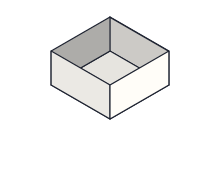
| Masu Box | Tant, washi or firm kami, 15–25 cm | Heavier paper gives sturdier walls |
| Jumping Frog | Index card or stiff paper | Stiffness gives the spring its power |
| Lucky Star | Paper strips about 1.5 cm wide | Folded from a strip, not a square |
| Paper Boat | A4, Letter or newspaper | Designed for a rectangle |
| Pinwheel | Duo paper, 15–20 cm | Shows two colors on the blades |
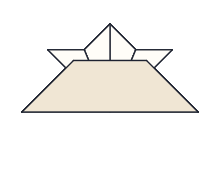
| Samurai Helmet | Kami, or newspaper square for a wearable hat | Scales up well |
What to buy first
- 1A pack of 15 cm kami in mixed colors. This covers nearly everything.
- 2A few 25 cm sheets for learning harder models or folding with children.
- 3Optionally, a small pack of patterned washi or chiyogami for gifts.
Store paper flat, away from direct sunlight (colors fade) and humidity (paper curls and softens). A large book or a folder works well.
TipBefore buying anything, print a few sheets with the printable origami paper tool and fold the Tulip or Heart. You will quickly find out which size feels comfortable in your hands.