Quick answer
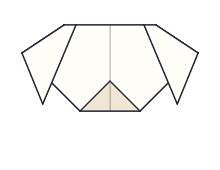
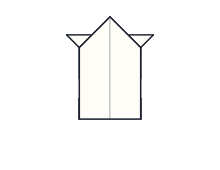
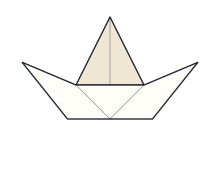
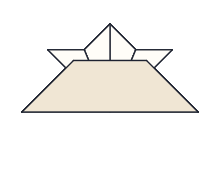
Young children (4–6) do best with very short models like the paper cup, dog face and tulip on large paper; children of 7–9 can fold the paper boat, fish, samurai helmet and heart; and 10–12-year-olds are ready for the jumping frog, masu box, butterfly and, with patience, the paper crane. No scissors are needed for any of these if squares are pre-cut.
Why origami is good for children
- Fine motor skills. Pinching, aligning and creasing build finger strength and control that also help with handwriting.
- Following a sequence. Each step depends on the last, so children practice listening, watching and doing things in order.
- Geometry by hand. Squares, triangles, diagonals, halves and quarters become physical rather than abstract. Folding a square in half along a diagonal is a very concrete way to see symmetry.
- Patience and resilience. A crooked first attempt improves on the second try, which is a gentle lesson in practice.
- Play at the end. Many kid-friendly models become toys: a frog that jumps, a boat that floats, a hat you can wear.
Models by age
Ages are only a rough guide. A patient six-year-old may out-fold a distracted ten-year-old, and every child should be allowed to try a harder model if they want to. When in doubt, go one level easier and use bigger paper.
Ages 3–5: first folds with help
At this age the goal is the feeling of folding, not a perfect result. Let children fold large squares in half and in half again, then help them finish a very short model. The Paper Cup and Dog Face work well: an adult can make the trickier folds and the child can make the big ones and draw the face.
Ages 5–7: short models on their own
- Dog Face and Fox Face: about three minutes each, finished with drawn eyes and a nose.
- Tulip: three folds for the flower, and a Tulip Stem for children ready for a few more.
- Paper Cup: a real container at the end, which children love testing.
Ages 7–9: more steps, more fun
- Paper Boat: folded from a rectangle, and it floats.
- Samurai Helmet: fold it from a large newspaper square and it can be worn.
- Fish: a quick model that makes a great group aquarium picture.
- Heart and Lucky Star: small, satisfying gifts. The star needs gentle fingers at the end.
Ages 9–12: intermediate challenges
- Jumping Frog: folded from an index card, it jumps, and frog races are a guaranteed hit.
- Pinwheel: spins in the wind once mounted on a stick (an adult should handle the pin).
- Masu Box: a useful box that locks without glue; fold a second one slightly larger as a lid.
- Butterfly: introduces collapsing a waterbomb base.
Ages 11 and up: the crane
The Paper Crane is an advanced model, but determined older children can manage it, especially on large 25 cm paper. Its story, and the Japanese custom of folding a thousand cranes, often motivates them to keep trying.
Advertisement
Folding at home: making it fun
- 1Fold it yourself first. Five minutes of practice means you can demonstrate confidently and spot where children will get stuck.
- 2Use big paper. For children under eight, 20–25 cm squares are far easier than standard 15 cm paper.
- 3Sit side by side, not opposite. Children copy more easily when your paper faces the same way as theirs.
- 4Show, then do. Make each fold slowly while they watch, then let them make the same fold. The animated diagrams on this site let children replay a step as many times as they need.
- 5Celebrate imperfect results. A slightly crooked fox is still a fox. Faces, colors and names make every model their own.
Tips for teachers and groups
- Pre-cut the squares. Cutting squares takes time and scissors. Prepare them beforehand, or print exact-size colored squares with the printable origami paper tool.
- Project the animation. Put the diagram on a screen and step through it fold by fold, pausing until everyone has caught up.
- Recruit helpers. Children who finish first can help a neighbor, which reinforces their own learning.
- Choose one model per session. Groups work best with a single short model that everyone finishes, plus an optional harder one for fast folders.
- Link it to the curriculum. Use folding to talk about fractions (halves, quarters, eighths), shapes and symmetry, or connect the crane to lessons on Japan and the story of Sadako Sasaki.
- Print the PDF. Every diagram on this site has a free printable PDF for tables without screens.
Safety notes
Origami is one of the safest crafts there is, but a few points are worth remembering:
- No scissors needed. None of the kids’ models on this site need cutting once you start from a square or a strip. Adults can prepare the paper, or children can use the fold-and-tear method in our square paper guide.
- Pins are for adults. Mounting a pinwheel on a stick uses a pin; an adult should do that part.
- Small parts. Tiny models like lucky stars are not suitable for toddlers who might put them in their mouths.
- Paper cuts. Crisp paper edges can nick fingers; slow, deliberate folding avoids most of them.
- Food and water. A paper cup can hold water for a short time, but it is a toy, not tableware.
Where to go next
Browse all origami for kids models, or the wider easy origami collection. For parties and seasonal activities, see origami crafts for parties and holidays. And if a grown-up is learning alongside, origami for beginners covers crease tips and diagram reading in more depth.